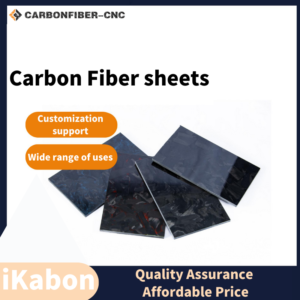
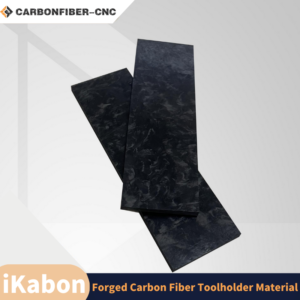
Forged carbon fiber sheets are compression-molded CFRP laminates made from chopped carbon fibers
consolidated in an epoxy matrix. They are selected for applications requiring
complex geometry capability, distinctive random appearance,
and stable CNC machinability in premium and engineering-grade parts.
Technical Note: What It Is (and What It Is Not)
Forged carbon is not a woven fabric laminate. Its appearance comes from chopped-fiber consolidation,
resulting in a naturally random pattern. Minor surface porosity may exist, and a completely pore-free surface
is not technically realistic. For projects with strict cosmetic requirements, finish expectations should be
confirmed in advance, with optional clear coat or post-processing considered.
Compression-Molded CFRP Panels with a Distinct Random Pattern
Forged carbon is formed by consolidating chopped fiber charge under controlled pressure and temperature.
The random fiber architecture supports complex part geometries and is commonly used for CNC-machined components
where both appearance and machinability are important.
Our forged carbon fiber sheets are manufactured under controlled processing conditions and undergo
visual and dimensional inspection to support consistent thickness, surface quality, and reliable machinability
for engineering and industrial use.
Why Choose Forged Carbon Fiber Sheets
Design Freedom for Complex Geometry
The chopped-fiber structure enables pockets, contours, and localized features that are difficult
to achieve with traditional woven laminates, making forged carbon suitable for complex CNC-machined parts.
Balanced Mechanical Response
Compared with directionally dominated laminates, forged carbon typically provides a more balanced
response across multiple directions, supporting applications with non-uniform or complex load paths.
Distinctive, Non-Repeating Appearance
Each sheet exhibits a unique random pattern. This visual individuality is widely valued in premium,
custom, and limited-run products where differentiation is important.
Manufacturing Process & Quality Control
Compression Molding Process
Forged carbon fiber sheets are produced by placing chopped carbon fibers and epoxy resin into precision molds.
High pressure consolidates the laminate, while controlled curing enhances structural integrity and surface stability.
Surface Quality Considerations
Due to the inherent characteristics of chopped-fiber compression molding, a completely pore-free surface
is not technically realistic. Through optimized molding parameters, resin control, and post-processing,
surface porosity can be minimized to an engineering-acceptable level.
Each sheet undergoes visual and dimensional inspection prior to delivery.
Surface Finish & Custom Configuration
Surface finish: Gloss or Matte
Surface side: Single-sided or Double-sided finish
Clear coat: Optional (recommended for enhanced surface protection and cosmetic consistency)
Inner / core options:
UD carbon fiber (commonly used as a structural core option)
Other materials (evaluated per project)
Final configuration should be reviewed based on part geometry, thickness target,
and intended application (decorative, semi-structural, or structural).
Specifications Summary
Item
Specification
Material
Forged carbon fiber (chopped-fiber CFRP)
Resin system
Epoxy
Manufacturing process
Compression molding
Thickness range
1–10 mm (customizable)
Size range
Width: 100–1000 mm · Length: 100–2000 mm (customizable)
Thickness tolerance
Typical ±0.1 mm (confirm per thickness and build)
Surface finish
Gloss / Matte
MOQ
No MOQ
Lead time
Typically within 7 days (subject to configuration)
CNC Machining & Engineering Notes
Suitable for CNC milling, drilling, pocketing, and contour machining
Consistent thickness supports repeatable dimensional control
Commonly selected for complex geometry with premium visual requirements
Edge sealing and finishing options can be discussed per design
Common CNC Use Cases
Cosmetic covers and housings with pockets, chamfers, and 3D contours
Mounting plates and brackets for small-batch engineering builds
Front panels, trim plates, and premium decorative inserts
EDC components (scales, backspacers) where pattern uniqueness is valued
Prototype parts requiring rapid iteration with stable machining behavior
Technical Note: Drawing & Edge Expectations
For repeatable CNC results, DXF or STEP files are preferred. If edges are exposed,
specify whether sealing or coating is required to align tooling strategy and finishing expectations.
Applications of Forged Carbon Fiber Sheets
Forged carbon fiber sheets are selected for applications requiring complex geometry,
distinctive appearance, and reliable CNC machinability.
Selection should consider whether the part is decorative, semi-structural, or structural.
Knife Handles & EDC Components
Typical thickness: 3–6 mm
Primary role: Decorative / Semi-structural
Engineering note: Edge sealing or clear coat recommended